
Gears for Corrosive Environments
Have you ever watched a piece of essential machinery slowly dissolve because of the very chemicals it’s designed to process?
Are you tired of the endless cycle of replacing "heavy-duty" metal components that simply can’t stand up to a corrosive environment? For those in the metal finishing industry, the irony is constant: the acids used to plate your parts are often the same substances eating through your overhead.
The Challenge: Durability in a Corrosive Environment
A large metal finishing company faced a significant operational hurdle. They needed to rotate massive plating barrel tanks filled with heavy metal parts. These barrels must spin continuously while submerged in chemical baths—often containing sulfuric, hydrochloric, or chromic acids—to ensure an even finish on the parts.
Traditional metal gears in this environment face two major failures:
- Chemical Corrosion: Even treated steel will eventually succumb to the harsh chemistry of a plating line.
- Maintenance Downtime: Once a gear begins to corrode, it loses its "pitch," leading to slipping, mechanical failure, and expensive downtime.
The client needed a solution that offered the mechanical strength of a large gear but with the chemical "immunity" of an advanced polymer.
The Solution
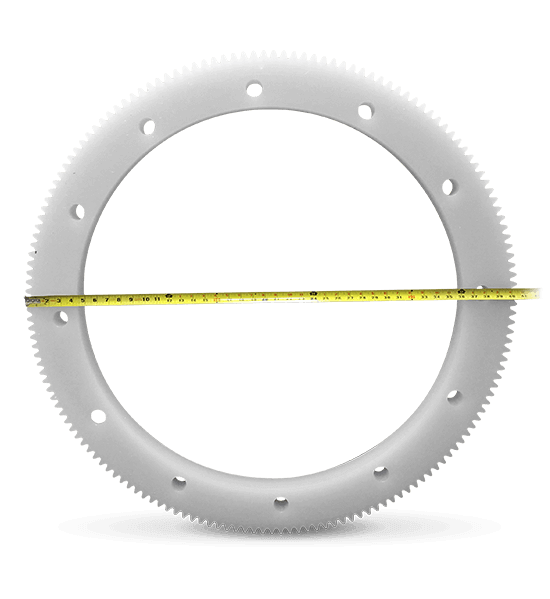
To solve the problem, APS turned to Polypropylene (PP). Polypropylene is a thermoplastic polymer known for its exceptional resistance to strong acids and bases. However, fabricating a gear of this scale—40 inches in diameter—requires more than just the right material; it requires precision engineering.
- Material Selection
We started with 2-inch-thick polypropylene sheets. At this thickness, the material provides the structural rigidity required to torque a fully loaded plating barrel, which can weigh thousands of pounds when filled with metal components and submerged in liquid. - N/C Machining and Precision Geometry
Using a large-scale N/C (Numerical Control) machining center, we first cut the 40-inch round blanks. Precision was paramount for the interior mounting holes; if the holes were off by even a fraction of a millimeter, the gear would wobble, causing uneven wear on the motor and the barrel. - Custom Gear Cutting
The most technical aspect of the build was the teeth. We upgraded our gear-cutting equipment and developed custom software instructions to mill 106 individual teeth into the circumference of the blank.
The Result: A "Bolt-On" Success
The final product was a set of massive, 106-tooth gears that were ready for immediate installation. Because polypropylene is significantly lighter than steel, the gears were easier to install, and the reduced weight placed less strain on the drive motors. Key Benefits Realized:
- Total Acid Resistance: Polypropylene is virtually impervious to the acids used in the plating process, meaning these gears will outlast metal counterparts by years.
- Zero Lubrication Required: Unlike metal gears, which require grease that can contaminate the plating baths, polypropylene gears are self-lubricating in many wet environments.
- Cost Efficiency: By eliminating the need for frequent replacements due to rust and corrosion, the client significantly lowered their long-term "Cost per Part."
Why This Matters for Plastic Fabrication
This case study proves that plastic is no longer just for small components or consumer goods. Through advanced CNC machining and specialized engineering, we can replace traditional materials in the most demanding industrial environments on earth.
When it comes to the "Really Big Gears" of industry, the future is precision-engineered plastic! Call us today at 800-783-3674 to get a quote on your next custom plastic fabrication project!